ސްކޫލްތަކުން މިއަދު ވާހަކަދައްކަން ޖެހިފައިވަނީ
އޮޅުންބޮޅުންތައް ގިނަ އަދި އޮޅުންބޮޅުންތައް އިތުރުވަމުންދާ ދަރިވަރުންގެ
އާބާދީއަކަށް ދިމާވާ މައްސަލަތަކަކާއިމެދު ގައެވެ. މިފަދަ ތަފާތު، މައްސަލަތަކެއް ދަރިވަރުންގެ
ފަރާތުން ކުރިމަތިވަމުން ދާއިރު، އެކަންތައްތަކަށް ދުރާލާ ތައްޔާރުވެ ބިނާކުރަނިވި
ފިޔަވަޅު އެޅުއްވުމަކީ މުދައްރިސުން ކުރައްވަން ޖެހިލައްވާކަމެކެވެ. މި ކަންތައް
މުދައްރިސުން ކުރައްވަން ޖެހިލައްވަނީ ޖަޒުބާތީ އަދި ސުލޫކީ މައްސަލަތައް ހުންނަ
ދަރިވަރުންނާއި އަދި އެނޫން ދަރިވަރުންގެ އުނގެނުން މަތިކުރައްވަން ކުރައްވާ
މަސައްކަތާއި އެކު އެކީގައެވެ.
Showing posts with label Info. Show all posts
Thursday, November 12, 2015
Thursday, October 22, 2015
Why do most runways have grass on the sides?
If it was concrete instead, wouldn't it be safer (if the aircraft skids off the runway while landing)?
At first, I would like to share a short story with you about how shoe was invented.
' Once upon a time there was a king. He was very upset about one thing that whenever he goes around his kingdom, his feet get dirty due to muck on the road. Finally he ordered his ministers to cover the complete globe with leather. The ministers kept on convincing him about the difficulty in implementation of such decision. But the king was unmoved. Finally they called for meeting and came across on a unique idea. They went to the king and told, "Me lord how about covering your feet with leather instead of the globe. Either way the muck would not touch your feet". And thus the shoe was invented. Probably that was something like this.
Now coming the topic. You can not have concrete everywhere in an airfield. There are various reasons behind it.
(1) The runway is a layered construction and it has different categories based on strength. This decides how much heavy load it can handle. It is identified with pavement classification number (PCN) which is an International Civil Aviation Organisation (ICAO) standard. The Kadhdhoo (VRMK) Aerodrome has PCN 15 Bituminous.
Here, how the layers are made.
You can not afford to have this kind of ground work done in complete airfield.
(2) How much extra potion should we cover? The aircraft can skid and go to even out of the airport.
(3) Lastly the most important one. The soft ground around the runway is responsible for saving the aircraft. The aircraft wheels get jammed in the soft ground and the aircraft stops. See the picture below. Had the sides been concrete, the aircraft would have been down the hills in pieces.
Natural brake.
Source: www.quora.com
By:
KATS
On 4:28 PM
Thursday, March 13, 2014
A young pilot's journey to her dream
Haveeru Online
Mar 13, 2014 - 08:57
Hearing that a 22-year-old girl is a pilot may be
unbelievable, but Aiminath Adam, 22, born unto Male, is a co-pilot for
Island Aviation Services (IAS) - the national airline of the Maldives.
She is also the first female pilot who wears the veil.
Though she wears
Pakistani clothes, the veil and sits in a cockpit as the second in
command, she is a fun-loving kid. Known as 'Amix' or 'Ant', she
graduated from the flying academy at Malaysia in May 2013 and has been
flying in the Maldives since January 2014. She spends an approximate
eight hours in a Dash-8 plane every day, making sure her passengers are
safe from the point of having taken off from the ground to landing
again.
It had been her childhood dream to fly in the air "like Superman and Spiderman". She wants to be a "Spiderwoman" who would help many people every day; to travel freely to countries all around the world.
Staying in one place quietly to even study had been a problem for her since childhood. She never desired to have A's in all subjects, receive report cards from the stage with applause or win educational crowns or stars, -but if she was shown the diagram of an engine from her physics book, she was the first to fill it out in her class. Aminath said that her growing love for engineering had flamed her dreams of becoming a pilot. Another reason for her interest in the field is her father, who is an engineer by profession and this had enabled her to grow up being able to observe his work. Her father also was one of her greatest supporter in fulfilling her dream of becoming a pilot.
"My father was an inspiration. I used to call him whenever I had doubts about my lessons and he would always clarify for me. Eve when I was a kid, he used to answer all the questions; like, I would ask him what a carburettor is and he would still explain. His explanations slowly sparked my interest. I started wishing I could ride something with such huge engines. That was when I decided I would become a pilot, that planes would have the biggest engines," she said.
Although flying in the air was her dream, the beginning was difficult for her. The first challenge was that her family did not want to allow her to work anywhere as she was a girl. After completing her O-Levels from Aminiya School in 2007, she applied to many places, asking for help to go study aviation. However, nobody responded then; they all said that this was too expensive a course. Aminath did not give up then. The only opportunity she found to become a pilot was to join the Maldivian National Defence Force (MNDF) air-wing, but she did not do it either on her mother's pleading.
"When I first told mother, she was not happy about it. Though my sister was working at MNDF, mother did not want her girls to work there. I felt really let down that day, cried a lot too, - but then thought that listening to my mother could bring me a better opportunity. I started looking for another job since then, but I always told my friends that I would become a pilot one day," Aminath conveyed how she had almost diverted away from her dream.
She had no wish to waste a single day in her life even if she could not be a pilot. Working as a shop clerk, she started studying business administration part-time. After a year of studying, she changed her field of work to a company called Palm Glow, which sold chemicals to resorts. She started studying IT while she was working at the administration department of the company, but she had still not let go of her dream to become a pilot. He sister, Fathmath Inaala became her biggest support in making her dream come true. From all the work her sister kept doing to get a loan for her to go abroad for her studies, luck caught up with them then. It was a unique chance.
"Even then my sister worked hardest at availing a loan for my education. She knew I talked about my pilot dream with my friends. She knew how much I wanted to be a pilot. After much trying, sister came and told me one day that I could get a loan from her work place, UN Women, lets apply. She applied for me and they agreed to give me a loan. She tried really hard for it," Aminath said.
The real hero in making Aminath's lifelong dream come true was her sister. She believes that her sister Inaala deserves all the credit for the story of how she accomplished her dream.
"She kept on supporting me throughout the course. She always checks on me. She was the closest person to me during those days. I realised my lifelong dream because of her. She always had my back whenever I needed anything," she explained.
Aminath began her voyage to achieve her dream from Sri Lanka in 2011, to do her IELTS before she left to study aviation. Staying with her brother who lives in Lanka, she passed in English Language, Mathematics and Physics enough to enrol at the university in a month's time. When she left to Malaysia, she was determined to not return to the Maldives before she became a pilot. She said that she stayed at a hostel during her whole stay in Malaysia to reduce her expenses and ensure that she did not get distracted with anything else.
"I told my lecturer that I was there to ride airplanes in my first class itself. Every day that I attended the theory classes, I kept wondering when I would be able to fly a plane ... I never believed for a minute that I couldn’t do this because I am a girl. I made it my ambition to do it. I didn’t want to waste this chance I got after so many years of trying. I knew I would succeed," Aminath said.
Even during her studies in Malaysia, Aminath kept on searching for a local airline that would hire a young girl in the Maldives. She kept on repeatedly applying to IAS long before she completed her studies. When she returned after finishing her course, she still waited for the work opportunity from IAS. Though job opportunities were available from the famous Malaysian airline AirAsia, she did not approach them as she had the honourable aspiration to serve her own country.
"Not long after I returned from Malaysia, IAS called me up for interview. I was really excited that day. I went for the interview with great confidence, determined to get the job this time. Then I had to wait for their response after the interview. The day I got to work as a pilot is the happiest day in my life, till now! ... I am most pleased for having the chance to serve my fellow Maldivians as a Maldivian woman. I wanted to work for IAS to serve my country in a diverse field like this, as a woman. This is also the greatest inspiration I have to climb higher in my career," Aminath explained enthusiastically.
After having joined IAS to serve Maldives, she had also attended a month long course in Spain to get acquainted with the Dash-8 planes. She is now looking forward to get promoted in her career; to fly higher in her pilot's career.
Her aim now is to achieve an Airline Transport Pilot License (ATPL) so that she can fly planes like the Airbus and the Boeing, - planes that are bigger than the Dash-8 series she is now flying with her Commercial Pilot License (CPL). To achieve this, she now has to do comparatively little work; put 1500 hours of flying under her belt.
She has set her foot down on accomplishing this as well. She is flying the Maldivian skies, being an exemplar to Maldivian women and youth.
By:
KATS
On 2:40 AM
Thursday, March 6, 2014
How Air Traffic Control Works
![]() |
| The various air traffic control facilities encountered by a plane during its flight |
Departure, En Route and Descent
Once your plane takes off, your pilot activates a transponder device inside the aircraft. The transponder detects incoming radar signals and broadcasts an amplified, encoded radio signal
in the direction of the detected radar wave. The transponder signal
provides the controller with your aircraft's flight number, altitude,
airspeed and destination. A blip representing the airplane appears on
the controller's radar screen with this information beside it. The
controller can now follow your plane.
An airplane's transponder transmits flight data to incoming radar signals.
The departure controller
is located in the TRACON facility, which may have several airports
within its airspace (50-mile/80-km radius). He or she uses radar to
monitor the aircraft and must maintain safe distances between ascending
aircraft. The departure controller gives instructions to your pilot
(heading, speed, rate of ascent) to follow regular ascent corridors through the TRACON airspace.
The
departure controller monitors your flight during ascent to the en route
portion. When your plane leaves TRACON airspace, the departure
controller passes your plane off to the center controller
(ARTCC controller). Every time your plane gets passed between
controllers, an updated flight progress slip gets printed and
distributed to the new controller.
En Route and Descent
Once
your plane has left TRACON airspace, it enters a sector of the ARTCC
airspace, where it is monitored by at least two air traffic controllers.
The radar associate controller receives the
flight-plan information anywhere from five to 30 minutes prior to your
plane entering that sector. The associate controller works with the
radar controller in charge of that sector. The radar controller
is in charge of all air-to-ground communication, maintains safe
separation of aircraft within the sector and coordinates activities with
other sectors and/or centers. The controllers must monitor the airspace
at high altitude (above 24,000 ft/7320 m) and low altitude (below
24,000 ft). The center controllers provide your pilot with updated
weather and air-traffic information. They also give directions to your
pilot regarding such aspects as speed and altitude to maintain a safe
separation between aircraft within their sector. They monitor your plane
until it leaves their sector. Then they pass it off to another sector's
controller.
Another controller, called the radar hand-off controller,
assists the radar and associate radar controllers during times of heavy
traffic, watching the radar screen and helping to maintain smooth
air-traffic flow.
While you are enjoying your meal, snack,
in-flight movie or the view outside the window, your plane gets passed
from sector to sector and center to center. In each sector, center
controllers radio instructions to the pilots. The path of your plane may
have to be changed from the original flight plan to move around bad
weather or avoid a congested sector. Your pilots may request a change in
altitude to avoid or reduce turbulence. This back and forth between
pilots and center controllers continues until you are about 150 miles
(241 km) from San Francisco (your destination). At this point, the
center controller directs all planes flying into San Francisco to move
from high altitudes to low altitudes and merges the descending aircraft
into a single file line toward the airport. The controller gives
instructions to your pilot, such as changes in heading, speed and
altitude, to place your plane in line with these other aircraft.
Depending on traffic conditions, the controller may have to place your
plane into a holding pattern, which is a standard route around each
airport, where you wait until the airport can handle your arrival. The
controller continues to give directions to your pilot until your plane
is within TRACON airspace.
By:
KATS
On 6:48 AM
Kadhdhoo Airport - Wikipedia
Kadhdhoo Airport Airport (Dhivehi: ކައްދޫ އެއަރޕޯޓް) (IATA: KDO, ICAO: VRMK) is a domestic airport located on the island of Kadhdhoo in Laamu Atoll, Maldives.[1][2] The airport is 3.7 km (2.0 NM) northeast of Fonadhoo.[1]
History
From its initial conception the project ranks among the development
program initiated by His Excellency President Maumoon Abdul Gayoom the
project implementation was supervised by the then Minister of Trade and
Industries-cum-Deputy Minister of Defense and National Security,
Honorable Ilyas Ibrahim.
Special mention has to be made of First Lieutenant Kairu Tuttu Maniku
for his active role in the implementation of the project. Likewise, Mr.
Kun’di Ali Saleem; Mr. Ahmed Mahreen, the senior Maintenance Technician
of the Civil Aviation Authority; Major Shaukath Ibrahim; Lieutenant
Ahmed Zahir; Lance Corporal Gasim Ahmed and Mr. Ranvikka Adam Maniku
then a Staff Sergeant of the National Security Service all made
significant contributions. The Ministry of Defense and National Security
and the State Trading Organization rendered valuable assistance during
the project’s early stages.
Excavation for the runway began on 11 January 1982, and the final layer of the runway was completed on 6 April 1986.
The project was implemented totally using local expertise, and though
it was initiated under the Government’s budget alone, additional
financial assistance was received from outside, notably from the United
Nations Development Program (UNDP), the International Civil Aviation
Organization (ICAO) and the Organization of Petroleum Exporting
Countries’ Fund (OPEC Fund).
The first aircraft to land at Kadhdhoo airport was an Air Maldives
Sky van flight on 10 December 1986. His Excellency the President of
Maldives Maumoon Abdul Gayyoom opened this airport. The length of the
runway at Kadhdhoo airport was 762 meters.
When the Maldivian president Maumoon Abdul Gayyoom assumed office in
1978, some of the most pressing problems faced by the country were the
immense difficulty involved in traveling between Malé and the outlying
islands and the adverse effects in the Maldivian fishing industry due to
illegal entry of foreign fishing vessels into the Maldivian territorial
waters.
As a step to solve the aforementioned problems, it was decided by the
present government to enact air links between Malé and four other vital
regions.
Kadhdhoo is an approximately large island situated halfway between the airport of Malé and Gan.
Kadhdhoo Airport in a glance. Type of airport: Domestic Estimated
load clarification no: 50 Runway Length: 762m Runway Width: 30m Apron:
105m x 22m Taxi-way 42m x 15m Largest aircraft that can be accommodated:
Short take-off and landing aircraft whose maximum weight does not
exceed 5700 kg.
Facilities
The airport resides at an elevation of 4 feet (1.2 m) above mean sea level. It has one runway designated 03/21 with a bituminous surface measuring 1,220 by 30 metres (4,003 ft × 98 ft).[2]
Airlines and destinations
Airlines offering scheduled passenger service:
| Airlines | Destinations |
|---|---|
| Maldivian | Gan, Male, Kaadedhdhoo, Kooddoo Airport |
By:
KATS
On 5:33 AM
How technology is improving air traffic control
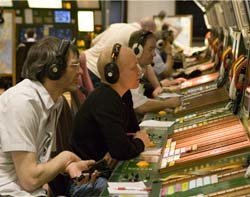
Controlling air traffic is one of the world's more stressful jobs. There's the "life and death" element, plus the need for razor-sharp reactions on everything from terrorist attacks to extreme weather. But despite the apparent complexity of the task, and the high-tech appearance of the equipment, it is still a job that relies completely on the ability and skill of its staff.
The basic process of finding the best route and landing safely would be simple if it wasn't for the thousands of flights dodging each other every day. The role technology plays in this process is, perhaps surprisingly, fairly minimal. The equipment looks impressive, and no flights would take off without being able to communicate with controllers, but the crux of the system still comes down to human decision-making.
As things stand, each controller receives information from 26 different air traffic management systems and must synthesise this into a schedule for each flight. If all goes well, the process is not complicated. The airline's operations department files a flight plan for each journey several hours before take-off is due, giving the flight's direction, speed, altitude and any other information needed to get it from A to B. The controller receives this, assesses it with other information available, and gives the flight the go-ahead. If anything changes during the flight, controller and pilot will communicate via encrypted radio or a satellite datalink.
The new centre at Prestwick controls the largest airspace in Europe. It handles 42% of UK air traffic and is the only provider of en-route airspace in the country, with all aircraft coming across the Atlantic going through it. It takes over from a control centre in Manchester, which now deals with flights taking off and landing from Manchester Airport. The move to Prestwick completes NATS' long-term plan to reduce the number of UK air traffic control centres from four to two, with the other centre being located in Swanwick, Hampshire.
Reducing delays
NATS says delays attributable to air traffic control have fallen from 21.9 seconds per flight in 2008 to 4.6 seconds in 2009. The number of flights with no delay has risen from 98% to 99.5%. This is partly down to the Traffic Load Prediction Device, which helps supervisors to plan more precisely for expected traffic and adjust staffing levels accordingly.
While human decision-making and spatial awareness are still the integral parts of the process, technology continues to improve it. Better presentation of flight data and improved distribution of flights between controllers has reduced the workload associated with every flight, helping staff to handle more flights at a time.
Plotting a flight's route
Flight data, including its intended route, the type of aircraft and its altitude, is currently printed out. A series of empty spaces on the paper are used to record instructions passed to the aircraft or information received from it. Several strips of paper are used for each aircraft, each relating to a different time and position. The controller compares the positions of each flight at a given time, and builds up a mental model of where they all are. He or she tells any aircraft that might conflict to turn, climb or descend to resolve any problems. The paper strips are stored for about 30 days after the flight has passed through the airspace.
The technical version of this - Electronic Flight Data (EFD) - is expected later this year, and will allow information on each aircraft to be shared more easily between controllers. It will also make potential conflicts or unusual circumstances more obvious.
Reducing the distance between flights
Environmental concerns notwithstanding, people keep flying and the skies keep getting busier. Technology is helping more flights take to the skies by improving the surveillance tools on board an aircraft, allowing them to fly closer together.
Traditionally, aircraft use high-frequency radio to report their position when crossing oceans. Satellite-based datalink communications have improved this, boosting accuracy and frequency. The next step is one many airlines have already taken: installing systems called Automatic Dependent Surveillance - Broadcast or Contract (ADS-B and ADS-C). These help an aircraft to accurately report its position and share it with other nearby aircraft, and it creates the possibility of allowing flights to travel closer together.
NATS says it is also trialling ways of working called In-Trail Procedures that could reduce separation from the current 10 minutes to five.
| Air traffic controllers |
|---|
| A tiny 3% of people accepted onto controller training courses complete the qualification. Astill says there are all sorts of reasons for this. The successful trainees have a well-developed ability to keep calm under high pressure, as well to receive and synthesise lots of different information. "In one ear you have someone on the telephone, in another you can have the pilot on the radio, and then you can be doing something else," says Astill, a former controller. "You need to be able to take lots of different sensory inputs and make sense of them." He says 80% of the job is about confidence; you really need to know what you are doing. Some technical knowledge is also required. Controllers need to understand the ins and outs of all the systems, as well as the basics of how radio and radar work, because if a part of the technology goes down, they need to know what they have lost, why they might have lost it, and possibly how to get it back. |
Protecting the system
The control room at Prestwick is protected by a Faraday cage, preventing the use of mobile phones. Ordinary business systems are completely separate from the control room systems, and there are several layers of firewalls.
Astill says the most likely thing to fail is the power. Prestwick's power comes from two separate supplies, and if both of these fail, four generators can take over. If these go down, there are 110 tonnes of batteries on site that will run the site for two hours. There is also an off-site contingency building, although the location is undisclosed.
The control room has four separate power threads, so if one fails, only a quarter of the room will be affected. Each controller has a workstation with two terminals, and no workstation has two terminals on the same power thread.
Chief systems engineer, Frank Crozier, says, "There is a huge amount of testing - months in some cases when we make changes to the software. We have multiple systems, so if one has a problem, we can switch to another. Glitches are always possible, but everything we do has a safety process around it. There's always a point when something will fail so we have procedures around it so we know how we'll handle it. The most important thing is talking to the pilot, so we have two support telephone systems."
Tracking flights
Radar tracks a flight until it is 160-180 miles from the control tower. Beyond that, aircraft are not tracked as they cross the Atlantic. Pilots have always kept track of where they are using in-flight navigational systems that work out how far they have travelled since they left the ground. The lack of radar is one reason why communication is important.
Technology enabling aircraft to be tracked by satellite exists, but has not been rolled out on a large scale. Aircraft do use satellite technology to decipher their own position, along with navigational systems and radar when they are passing a beacon. But air traffic control does not have the IT to track them, relying on pilots to communicate their whereabouts if it differs from the flight plan. Few aircraft are equipped with the technology controllers would need to track them, so the incentive to invest in new IT won't be there unless airlines also upgrade their systems.
A fully automated air traffic control system is probably unlikely. Technology goes wrong; a human would still be needed to watch the systems, correcting them when their automated decisions are not the right ones. The problem with that is, as with any highly skilled role, you need to keep practising to stay good, and watching the systems do it is not the same as doing it yourself.
| Emergencies |
|---|
| Air traffic controllers play a role in dealing with national
and international emergencies, and must be ready to act if something
big happens. When the terrorist attacks took place in New York in 2001,
the US closed its airspace and UK air controllers were left with half an
Atlantic full of aircraft, about 200 in total. The aircraft had to take
care of themselves as they each turned around with about 60 miles
between them, and returned to the UK. "Extra staff came in to help without being asked, because they knew things were going to get interesting," says Astill. But the process got easier as outgoing flights were cancelled, freeing up space. |
By:
KATS
On 4:37 AM
Subscribe to:
Posts (Atom)